LT260404: Why did the Tunguska Event leave no meteorite fragments?
What was the Tunguska Event?
Back in 1908, the Tunguska event rocked the remote Siberian wilderness with an explosion so powerful it flattened over 2,000 square kilometres of forest. Trees were scorched and toppled in a mind-boggling radial pattern, but the most baffling part? No crater or meteorite remains were found.
Now we can see a reason for the lack of remains. The object causing the explosion was just an enormous lump of ice. Composed entirely of frozen water, the meteor ended up as steam or liquid water.
Approximately 90% to 95% of meteors that enter Earth's atmosphere leave no solid remains. This is understandable for smaller meteors -- even if they consisted of rock or metal, they could vaporize completely while in the air. But bigger ones need a different explanation.
It would be a surprise to most people to learn that the Earth is under continual bombardment by huge chunks of ice, but that is the case.
Louis Frank's Snowballs
During the 1950s, an American scientist named Louis Frank came across a puzzling feature of atmospheric science which would eventually lead to an astonishing new fact about the Earth [Reference A]. Our planet is under bombardment by house-sized balls of water ice, not occasionally, but sometimes as often as 20 times a minute.
Frank described his discoveries, and the considerable doubts which he had to overcome to get them accepted, in his 1990 book "The Big Splash". This book is worth reading both for the story of his discoveries and for a gritty account of the realities a new discovery faces when it comes up against the established world.
Frank called these ice-balls "small comets", and speculated that they originated from the Oort Cloud which surrounds our Solar System, but in fact they have a much more local origin. It has become clear that these ice-balls commonly populate the whole of the Earth's orbit around the Sun, and possibly a lot more of the interplanetary realm.
Also very surprising was the extent to which these ice-balls impacted the Earth. These balls weigh as much as 100 tons each. Frank says "A small comet falls into the Earth's atmosphere about every 3 seconds. Each one contains about 100 tons of water. Some 25,000 such objects fall to the Earth each day, or about 10 million on average over the course of a year".
These figures were startling enough to cause a genuine reaction to their acceptance. Ten million objects each weighing 100 tons represents a billion tons a year. If the Louis Frank Snowballs were actually adding a billion tons to the Earth's mass each year, there would be major ramifications.
A long-standing topic of interest is where Earth's water comes from. The traditional idea is that it was boiled out of the Earth's rocks during a very long geological history, extending over 4.5 billion years. But although there is an awfully large amount of water on Earth (about 1.26 trillion tonnes), if ice-balls were adding a billion tons a year over the Earth's history, this would be much more than we calculate exists in the present oceans and water bodies!
The answer to this problem is simple. While ice-balls may be adding a billion tons a year to Earth's water, it is also losing a billion tons a year through evaporation of water vapour at the edge of the atmosphere -- Earth's water stocks are in equilibrium.
How we know the ice-blocks have local origin?
While the vast majority of Louis Frank Snowballs are turned into water vapour high in the atmosphere, some. like the Tunguska ice mountain, are big enough so their cores still have enough mass for them to reach the ground.
These ice-ball cores are called Megacryometeors (means big cold meteors). There is an entry for Megacryometeors in Wikipedia, though this states that their origin is not understood.
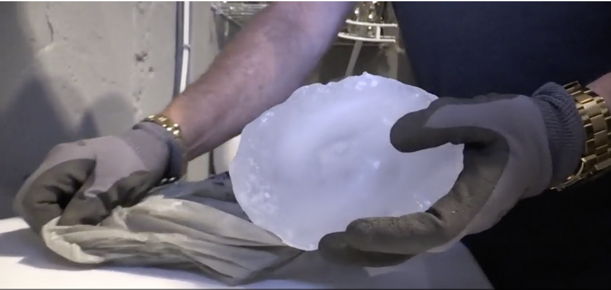
Fig. LT260404-F1. The 2018 Canadian Megacryometeor. From [A].
It seems very possible that similar ice-balls are common throughout the Solar System from Earth's orbit outward, regions where the equilibrium temperature of a body in space is below freezing. Saturn's Rings are accepted as as made up of such ice-balls, averaging up to 10 metres across.
Even in the colder regions of the Solar System, ice bodies will be subject to equilibrium regimes where sublimation and condensation are balanced. Larger ice-bodies may form strings of "trojan-orbit" bodies accompanying planets and asteroid-belt objects.
The Louis Frank Snowballs appear to be made of pure water, without the solids common in comets. The Earth appears to be running into bodies sitting in its orbit, since LFSs are more frequent on its leading face. It is a significant that LFSs have been determined to have formed at a temperature of -10 to -20 degrees Centigrade, which is exactly the average temperature of isolated bodies (such as the Moon) at Earth's distance from the Sun.
The light from meteor trails
The essence of a meteor is a trail of light in the sky -- how is the light generated? Since meteorites (the solid remains which fall to the ground) show evidence of great heat in their fused exteriors, it might be thought that the light comes from burning of their solid (stony or metallic) content, which would not happen with pure ice.
But, in fact, the light of a meteor trail is generated by the extreme heating of air and the vaporization of the meteoroid itself as it enters Earth's atmosphere at high speeds (often 11 to 72 km/s). The process, technically called ablation, happens with any solid, including ice, able to compress the air.
So the light is not primarily from friction, but rather from adiabatic compression—the rapid compression of air in front of the object creates a hot plasma that emits light, similar to a "natural fireworks show".
* * * * * * * * * * *
AOI articles of relevance
[A]. EP307: Louis Frank Snowballs and Condensation of Interplanetary Matter.
 Item: LT260404
Perth, Western Australia.
Last update 2026 Apr 19.
